Wednesday, January 4, 2012

Problems of 1/4/2012

With the new year here it is time for BORAT to be on the fast track to first light. The history of the "Things To Do" list is something fixed, another item comes up. Same is true with this list, some of our original driver code giving us troubles.

Soon will have pics up of electrical and maybe inside of dome with final equipment.

Software
  • AstroHaven dome driver needs update to stop spamming error messages and to add feedback from new dome control hardware - Currently Rewriting
  • Add user friendly GUI to control primitive features of the system - Website in progress
  • Current SVN RTS2 won't compile with our drivers - DONE
Hardware
  • Repair crack on AstroHaven Dome - Still don't know what to do...??...
  • Add lens heater on LX200GPS to reduce night dew. - Held off till summer
  • Focuser rewire - DONE
Security
  • Dome lights need work - DONE
  • All external wiring needs to be finished - DONE
  • ZM notification needs to be solved

Wednesday, October 12, 2011

Problems of 10/12/2011

Finally our list is getting smaller and smaller. Some of the items have to be performed on site like dome driver fixing. Another thing to add to the list is much testing. This weekend hopefully should be able to get first light.

Software
  • AstroHaven dome driver needs update to stop spamming error messages and to add feedback from new dome control hardware
  • Add user friendly GUI to control primitive features of the system - Starting
Hardware
  • Buy cabling management for inside of dome
  • Repair crack on AstroHaven Dome
  • Still need to spec out computer capable of extreme temperatures. Computer still needs to have PCI slots and serial ports. Don't want to use USB<->Serial
  • Add lens heater on LX200GPS to reduce night dew.
Long Term
  • Possibly add Android app interface/add
  • Draw a plan for UPS during extreme temps

Monday, October 3, 2011

Telescope In Dome

Finally after several months of writing driver and hoping political messes the telescope is finally in. Not yet tested hopefully little testing has to be done and lots of trial runs.


With the telescope pointed at zenith with dome closed only two inches of clearance. You might wonder where am I in the pictures. I am just the guy taking the pictures. ;)

BigNG vs Insect

After four months of running our fan controller suddenly stopped responding in RTS2. Direct serial communication produced nothing either. Getting frustrated I took it from the dome to campus to work on it. By chance I happen to inspect it and noticed corrosion on some if the ICs.

On the lower left black chip the corrosion is the worse. Several pins on the IC are simply gone. This chip happens to be the USB controller hence the bad USB communication. There was some bug poo on the IC chips themselves that I scrapped before taking picture. Next fan controller I will put in an enclosure to prevent this.

Monday, September 26, 2011

Problems of 9/25/2011

Got a lot accomplished since last list but as usual more problems creep up over time.

Software
  • Focus driver - implementing in RTS2 - DONE
  • AstroHaven dome driver needs update to stop spamming error messages and to add feedback from new dome control hardware
  • TBan driver needs code to handle when device is not there rather than spam messages - DONE
  • Add user friendly GUI to control primitive features of the system
  • Possibly add Android app interface/add
Hardware
  • Ordered another Webswitch, they are so cool - DONE
  • Mount Telescope and pier - DONE
  • Buy cabling management for inside of dome
  • Repair crack in AstroHaven Dome
  • Still need to spec out computer capable of extreme temperatures. Computer still needs to have PCI slots and serial ports. Don't want to use USB<->Serial
  • Draw a plan for UPS during extreme temps - put off
  • Add lens heater on LX200GPS to reduce night dew.
  • Corrosion on BigNG board - ordered new one - DONE

Wednesday, September 7, 2011

Binning and RTS2

Recently we've been having some troubles getting binning to work under RTS2 with our Alta CCD. Binning is a technique that can be used to speed up the dead time spent reading an image from the CCD - something that is very useful for the kind of high frame rate we wish to achieve with our system.

During testing a month or two ago we found that our Alta U47 would become unresponsive after setting the binning to 2x2 in the RTS2 monitor. The camera essentially stops responding to commands and needs to be power cycled to come back to life. I've been debugging the Apogee drivers forked in the RTS2 codebase for a while until I stumbled onto a quick fix: simply set the binning in the CCD script instead of directly in the monitor! I'm not sure why I didn't try this earlier. Here's an example:

rts2-scriptexec -d C0 -s 'binning=1 E 2 E 2'

This script sets the binning and then exposes twice for 2 seconds each. The readout time is about 0.5-0.8 seconds for each frame. Note that 1x1 binning is actually selected as "binning=0" and 2x2 is "binning=1" in the script.

Wednesday, August 17, 2011

The Instrument

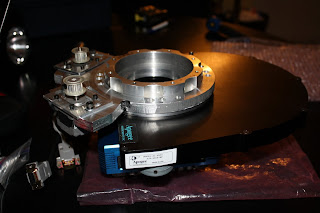
Our system will be using an instrument composed of a custom focuser, filterwheel, and CCD. These pieces must be assembled each time we attach it to the telescope. When the security system matures and we have the fence installed we will be able to leave it at the site in one piece.

The focusing device is essentially two motors on a specially constructed piece of metal to operate the telescope's focus knobs. It's in the upper right of the photo.

The filterwheel is a USB Apogee AFW50-9R. It takes 50mm round filters (we have U, V, B, R, and I). The driver had to be tweaked a bit but now it works well in RTS2.

Our CCD is an Apogee Alta U47. For all the details you can see their official specs here. We have three of these devices at our observatory and use them in several projects. We're currently having some issues with the RTS2 integration (some binning issues) but expect to have it sorted out soon. 

The actual assembly of this instrument takes about 15 minutes to an hour, depending the experience of the person doing the assembly. It takes a total of 5 different hex wrenches to complete! The CCD connects to a mounting plate and then to the filterwheel. The filterwheel is screwed into an adaptor plate and this is bolted to the focus ring. After this, all you have to do is carefully screw it onto the back of the telescope and attach the cables and belts. I personally can't wait until we can put everything together and leave it at the observatory.
The completed instrument with all the rings and equipment connected weighs about 10 pounds. Our counter weight system only went to 6 pounds and this proved to be a problem when it comes to tracking on the Meade forkmount. That is a problem for another post, though!